Pythagorean Theorem Word Problems by Dolores Salguero González on Scribd
Mostrando entradas con la etiqueta 2º ESO. Mostrar todas las entradas
Mostrando entradas con la etiqueta 2º ESO. Mostrar todas las entradas
martes, 2 de mayo de 2017
Pythagora´s theorem
Os dejo las actividades correspondientes a Pitágoras, para entregar el día del examen.
Si tenéis alguna duda, por favor, consultádmelo en clase.

lunes, 1 de mayo de 2017
martes, 4 de abril de 2017
Tarea integrada 2 ESO C. Índice de masa corporal
En el vídeo el alumnado va a calcular su índice de masa personal y también explicar lo que es la ecuación del balance energético.
The body mass index (BMI) is a value derived from the mass (weight) and height of an individual. The BMI is defined as the body mass divided by the square of the body height, and is universally expressed in units of kg/m2, resulting from mass in kilograms and height in metres.


Pi Number
 El día de pi, se celebra el 14 de marzo alrededor del mundo. Pi es una constante matemáticas que representa un número irracional, con infinitas cifras decimales.
Pi Day is celebrated on March 14th (3/14) around the world. Pi (Greek letter “π”) is the symbol used in mathematics to represent a constant — the ratio of the circumference of a circle to its diameter — which is approximately 3.14159. Pi has been calculated to over one trillion digits beyond its decimal point. As an irrational and transcendental number, it will continue infinitely without repetition or pattern. While only a handful of digits are needed for typical calculations, Pi’s infinite nature makes it a fun challenge to memorize, and to computationally calculate more and more digits
El alumnado de 2º ESO A-B y Grace, auxiliar de conversación, han realizado un vídeo en el que se conmemora ese día, esperamos que os guste...
sábado, 25 de marzo de 2017
jueves, 16 de marzo de 2017
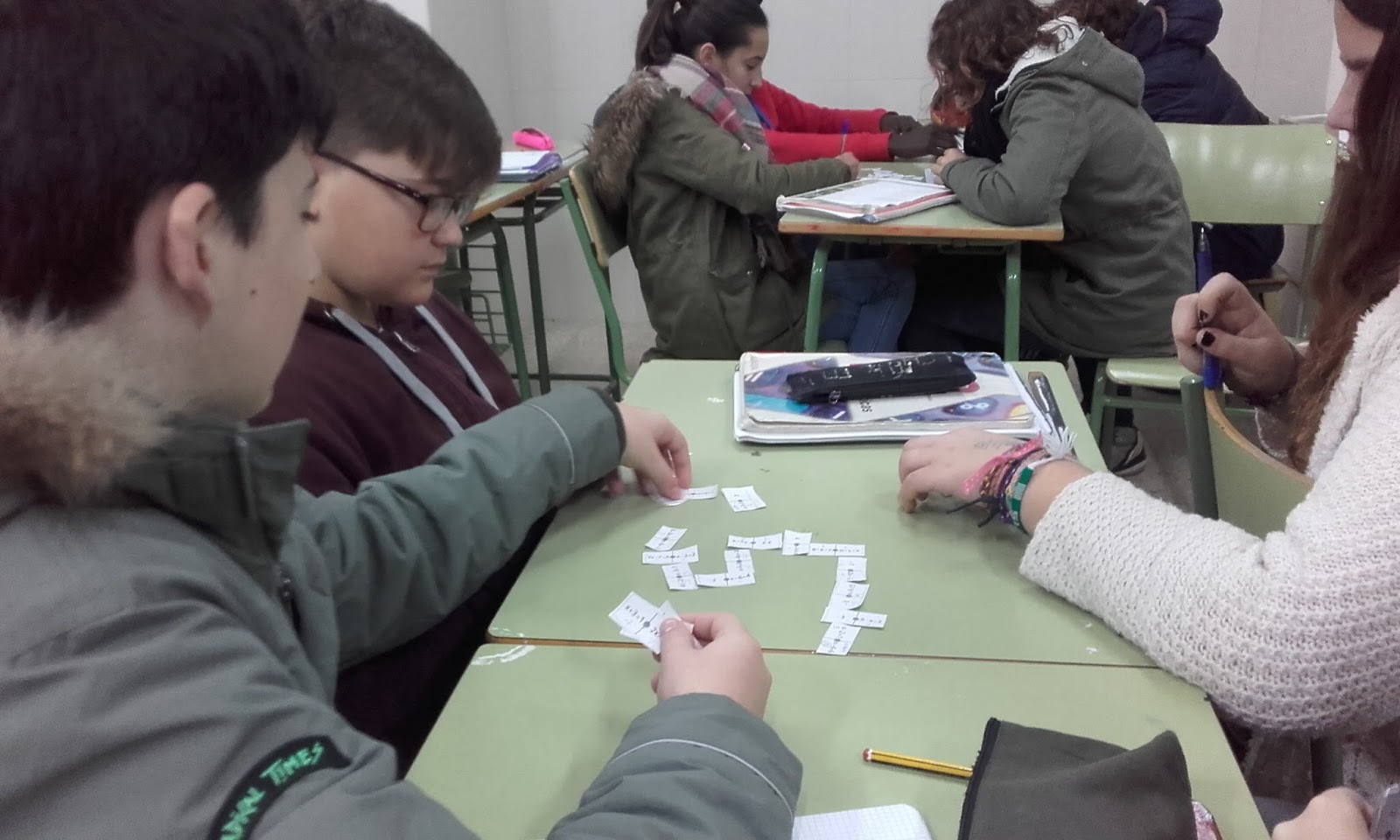
Dominó de ecuaciones. 2º ESO bilingüe
En 2º ESO, el alumnado ha repasado las ecuaciones de primer grado, jugando un dominó especial...




domingo, 19 de febrero de 2017
sábado, 18 de febrero de 2017
Equations 2º ESO Bilingual
Os dejo las actividades para refuerzo del tema de fracciones. Tiene las soluciones para que os ayude a ver si lo estáis haciendo bien
Equations. Activities by Dolores Salguero González on Scribd
viernes, 20 de enero de 2017
miércoles, 21 de diciembre de 2016
sábado, 3 de diciembre de 2016
jueves, 24 de noviembre de 2016
martes, 8 de noviembre de 2016
jueves, 13 de octubre de 2016
jueves, 22 de septiembre de 2016
Divisibility Criteria
Mathematics (Bilingual)

Divisibility
Criteria:
Divisible
by 2
A
number is divisible by 2 if the last digit is 0, 2, 4, 6 or 8.
Example:
2 346 is divisible by 2 because the last
digit is 6.
Divisible
by 3
A
number is divisible by 3 if the sum of the digits is divisible by 3.
Example:
23 457 is divisible by 3 because the sum
of the digits is 21 (2+3+4+5+7=21), and 21 is
divisible
by 3.
Divisible
by 4
A
number is divisible by 4 if the number formed by the last two digits
is either 00 or divisible by 4.
Example:
24 516 is divisible by 4 because 16 is
divisible by 4.
Divisible
by 5
A
number is divisible by 5 if the last digit is either 0 or 5.
Example:
9 876 345 is divisible by 5 because the
last digit is 5.
Divisible
by 6
A
number is divisible by 6 if it is divisible by 2 (the last digit is
0, 2, 4, 6 or 8) and it is also
divisible
by 3 (the sum of the digits is divisible by 3)
Example:
534 is divisible by 6 because is divisible
by 2 (the last digit is 4) and it is divisible by 3 (the sum of the
digits 5+3+4=12 is divisible by 3)
Divisible
by 10
A
number is divisible by 10 if the last digit is 0.
Example:
12 345 890 is divisible by 10 because the
last digit is 0.
Divisible
by 11
To
check if a number is divisible by 11, sum the digits in the odd
positions counting from the left (the first, the third, …) and then
sum the remainder digits. If the difference between the sums is
either 0 or divisible by 11, then so is the original number.
Examples:
145 879 635 918 291
Digits
in odd positions: 1+5+7+6+5=24 Digits in odd positions: 9+8+9=26
Digits
in even positions: 4+8+9+3=24 Digits in even positions: 1+2+1=4
The
difference is 24-24=0 The difference: 26-4=22
So
145 879 635 is divisible by 11. So 918 291 is divisible by 11.
jueves, 23 de junio de 2016
Suscribirse a:
Entradas (Atom)